
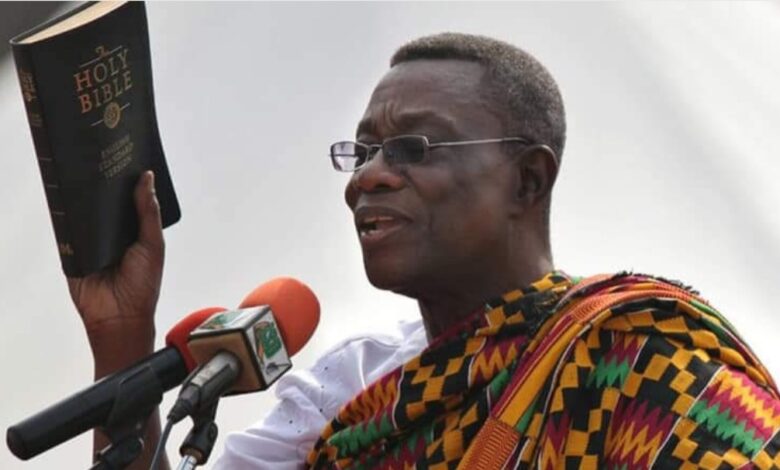
EARLY LIFE AND EDUCATION
John Evans Atta Mills was born on July 21, 1944, in Tarkwa, in the Western Region of Ghana. He hailed from Ekumfi Otuam in the Central Region, a heartland of the Fante people. Mills demonstrated an early aptitude for academics, which laid the foundation for his future career.
Mills attended Achimota School for his secondary education, where he excelled in his studies. He proceeded to the University of Ghana, Legon, where he earned a bachelor’s degree in law (LL.B.) in 1967. His quest for higher education took him to the London School of Economics and Political Science (LSE), where he completed a postgraduate LLM program. Mills furthered his academic credentials by earning a Ph.D. in Law from the School of Oriental and African Studies (SOAS), University of London, specializing in taxation and economic development.
ACADEMIC CAREER
Mills returned to Ghana and joined the University of Ghana, Legon, as a lecturer. His teaching career spanned over 25 years, during which he became a full professor and contributed significantly to the fields of law and taxation. His expertise was not confined to Ghana; he also served as a visiting professor at Temple University in Philadelphia, USA, where he continued to share his knowledge and insights with a global audience.
POLITICAL CAREER
Mills’s entry into politics was marked by his selection as Vice President of Ghana, serving under President Jerry John Rawlings from 1997 to 2001. This period was crucial in shaping his political ideology and providing him with the experience needed for higher office.
PRESIDENCY (2009-2012)
In 2008, Mills was elected as the President of Ghana, representing the National Democratic Congress (NDC). His victory marked the beginning of a presidency focused on economic stability, social justice, and peace. Mills was inaugurated on January 7, 2009, and his tenure was characterized by significant achievements in various sectors.
HONESTY AND HUMILITY
John Evans Atta Mills was known for his honesty and humility, traits deeply rooted in his Fante heritage. Fante culture places a strong emphasis on integrity, respect, and community, values that Mills embodied throughout his life. His straightforwardness and transparent approach to governance earned him the respect and admiration of both his supporters and critics. Remarkably, throughout his decades of service to the Republic of Ghana, there was never a single scandal of corruption associated with him. Mills’s humility was evident in his interactions with people from all walks of life; he was approachable and always willing to listen. This Fante-cultured leader’s modesty and principled stand made him a beloved figure, known for his unwavering dedication to the service of Ghana and its people. His anti-corruption stance starved corrupt groups in Ghana, who in turn launched unjustified attacks on his gentle nature in an attempt to tarnish his image. However, they couldn’t succeed, and even though he died in office, in their minds, he earned their utmost respect, knowing they could never match him in leadership.
Even while serving as the president and holding the highest office in the country, Mills demonstrated that the Fante values of honest living, truthfulness, humility, anti-corruption, and respect for all, regardless of background, were not mere rhetoric but a true reflection of their nature. His leadership proved that these virtues were deeply ingrained in Fante culture and practice, showcasing the integrity and ethical principles that the Fante hold dear.
ECONOMIC ACHIEVEMENTS
• Stabilization and Growth: Mills implemented policies aimed at stabilizing the Ghanaian economy, which included fiscal reforms and prudent economic management. His administration worked to reduce inflation and maintain a stable exchange rate.
• Infrastructure Development: Under his leadership, significant investments were made in infrastructure projects, including roads, schools, and hospitals, which facilitated economic growth and improved living standards.
• Foreign Investment: Mills’s policies attracted substantial foreign investment, contributing to the development of the oil and gas sector, which became a significant part of Ghana’s economy.
SOCIAL ACHIEVEMENTS
• Education: Mills prioritized education, expanding access to free basic education and increasing funding for educational institutions. His administration worked on improving the quality of education and expanding educational infrastructure.
• Healthcare: Mills’s government improved healthcare services, building new hospitals and clinics and upgrading existing ones. His focus was on making healthcare accessible and affordable for all Ghanaians.
• Social Equity: Mills was committed to social justice and equity. His policies aimed at reducing poverty and bridging the gap between different socio-economic groups.
INTERNATIONAL RELATIONS
Mills strengthened Ghana’s international relations, fostering cooperation with other nations and international organizations. His tenure saw Ghana playing a more active role in regional peacekeeping efforts and contributing to the stability of West Africa.
DEATH AND LEGACY
John Evans Atta Mills passed away on July 24, 2012, while still in office. His sudden death was a significant moment in Ghanaian history. He was succeeded by his Vice President, John Dramani Mahama. Mills was remembered for his humility, dedication to public service, and his calm and steady leadership style.
Mills left behind a legacy of integrity, hard work, and a commitment to the welfare of Ghanaians. His contributions to education, healthcare, economic stability, and international relations have had a lasting impact on Ghana’s development. His presidency is often cited as a period of peace and steady progress, and he remains a respected figure in Ghanaian history. He set a good example that every Fante and Ghanaian should always uphold and replicate for a better society. Mills’s achievements continue to inspire future generations of leaders in Ghana and beyond.


